


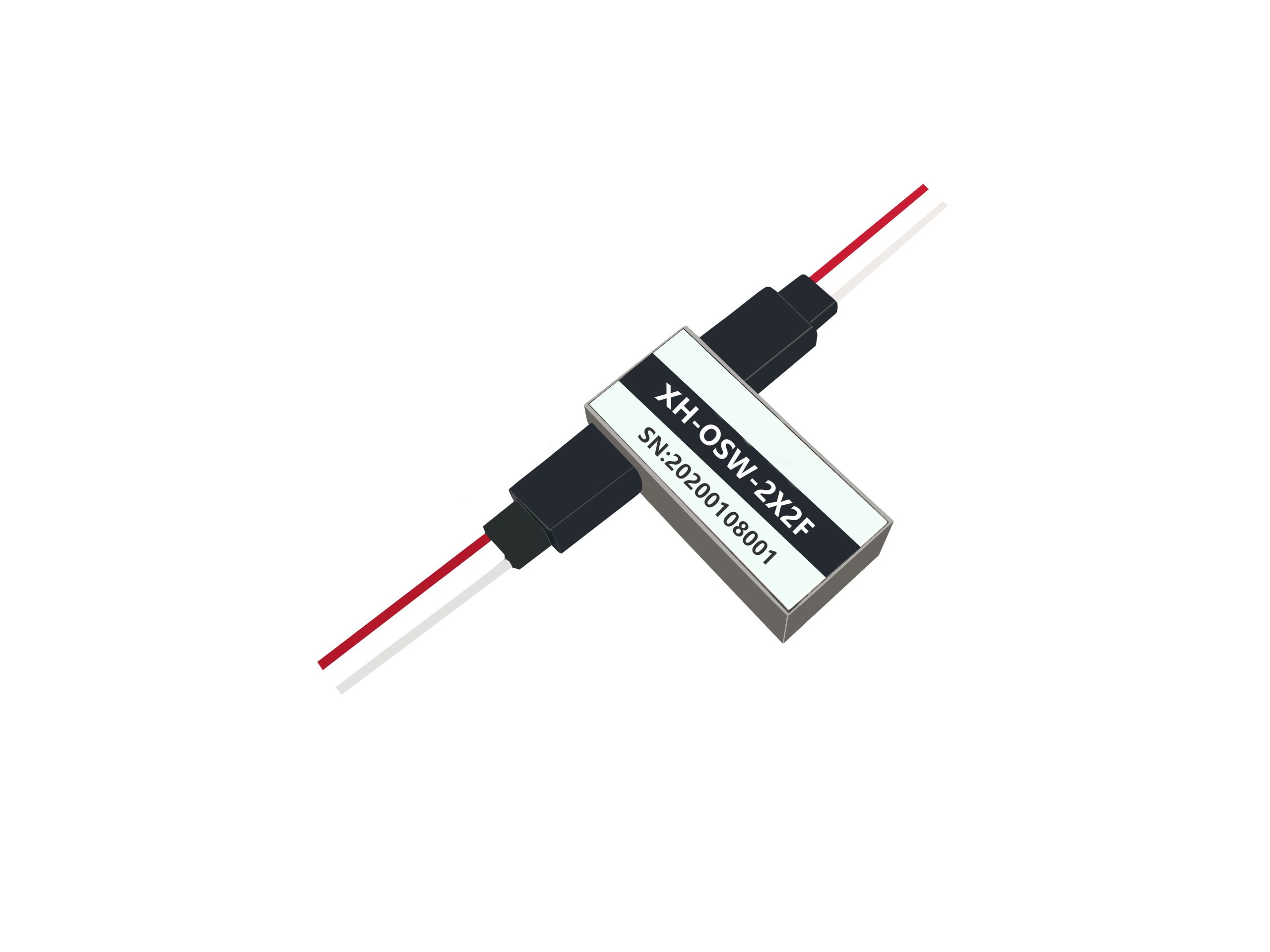
Can a 2×2F Mechanical Optical Switch Improve Network Reliability?
In optical communication networks, data centers, fiber optic sensing systems, and industrial automation, network reliability is critical to ensuring uninterrupted services. A failure in the primary optical link can lead to communication downtime, data loss, and costly service interruptions.
To minimize these risks, more and more systems are adopting 2×2F Mechanical Optical Switches for automatic optical path protection and redundancy. But how exactly do they improve network reliability? This article explains their working principle, key advantages, and typical applications.
What Is a 2×2F Mechanical Optical Switch?
2×2F Mechanical Optical Switch is a passive optical device that uses a precision mechanical mechanism to switch optical paths. It features two input ports (P1, P2) and two output ports (P3, P4), allowing the optical signal to be routed between two different connection states.
Unlike electronic switching, it does not perform optical-to-electrical conversion, ensuring minimal signal loss and maintaining excellent optical performance.
Its key features include:
- Low Insertion Loss
- High Return Loss
- High Isolation
- Bidirectional Transmission
- Long Service Life (typically over 100 million switching cycles)
- Latching Design (maintains the switching state even when power is removed)
How Does a 2×2F Mechanical Optical Switch Work?
The figure below illustrates the two typical switching states of a 2×2F Mechanical Optical Switch.
Figure 1. Optical Path Diagram of a 2×2F Mechanical Optical Switch
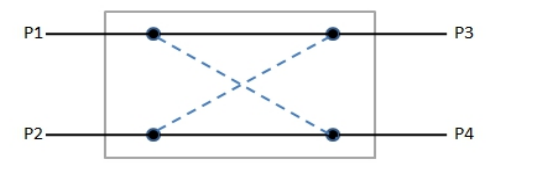
From the diagram, the switch supports two operating states:
State 1 – Bar State (Straight-Through Connection)
- P1 → P3
- P2 → P4
In this state, optical signals travel directly through the switch. This is typically the default operating mode during normal system operation.
State 2 – Cross State (Cross Connection)
- P1 → P4
- P2 → P3
When the internal mechanical actuator is activated, the optical paths are crossed, redirecting the signals to the alternate ports. This enables rapid switching to a backup fiber link or another optical device.
This flexible switching capability makes the 2×2F Mechanical Optical Switch an essential component in Optical Line Protection (OLP) systems and redundant network architectures.
How Does a 2×2F Mechanical Optical Switch Improve Network Reliability?
1. Enables Automatic Optical Path Protection
Mission-critical optical networks often deploy two independent fiber links:
- Primary Link
- Backup Link
If the monitoring system detects abnormal optical power or a failure in the primary link, the controller immediately commands the mechanical optical switch to redirect traffic to the backup path.
This automatic protection significantly reduces downtime and improves overall network availability.
2. Reduces Single Points of Failure
Without redundancy, a damaged fiber or failed optical device can interrupt the entire communication system.
A 2×2F Mechanical Optical Switch enables pre-configured redundant optical paths. In the event of a failure, it automatically reroutes the optical signal, minimizing service disruption and improving system resilience.
3. Simplifies Maintenance and Reduces Operating Costs
Routine maintenance often requires switching optical connections for equipment replacement, testing, or upgrades.
Manual fiber reconnection can lead to:
- Fiber end-face contamination
- Connector wear
- Increased insertion loss
- Human errors
Using a mechanical optical switch allows remote optical path switching, reducing manual intervention, shortening maintenance time, and extending connector lifespan.
4. Maintains Excellent Optical Signal Quality
Since the switch uses a purely mechanical optical path, no optical-to-electrical conversion occurs during switching.
As a result, it provides:
- Low Insertion Loss
- High Return Loss
- Excellent Repeatability
- Stable Optical Performance
Even after millions of switching cycles, the device maintains consistent performance, making it suitable for high-precision communication and testing applications.
Typical Applications
Optical Line Protection (OLP)
Provides automatic switching between primary and backup fiber links to ensure uninterrupted network operation.
Data Centers
Used for:
- Redundant fiber routing
- Network failover
- Optical module testing
- Fiber resource sharing
Enhancing overall network reliability and operational efficiency.
Fiber Optic Sensing Systems
Supports automatic channel switching in applications such as:
- Distributed fiber optic sensing
- Temperature monitoring
- Strain monitoring
Improving system flexibility and measurement efficiency.
Automated Test Equipment (ATE)
Enables automatic routing between test instruments and devices under test (DUTs), improving testing efficiency while reducing manual operations.
Research Laboratories
Widely used for laser routing, optical experiment setup, and optical component testing, providing flexible and repeatable optical path management.
How to Choose the Right 2×2F Mechanical Optical Switch
When selecting a mechanical optical switch, consider the following specifications:
| Parameter | Considerations |
|---|---|
| Fiber Type | Single Mode (SM), Multimode (MM), Polarization Maintaining (PM) |
| Operating Wavelength | 850 nm, 1310 nm, 1550 nm, or custom wavelengths |
| Insertion Loss (IL) | Lower values provide better transmission efficiency |
| Return Loss (RL) | Higher values reduce optical reflections |
| Switching Time | Should meet your system’s response requirements |
| Control Interface | TTL, RS-232, USB, Ethernet, etc. |
| Operating Temperature | Industrial or outdoor environmental requirements |
| Lifetime | Prefer models rated for over 100 million switching cycles |
Conclusion
As technologies such as 5G, AI data centers, fiber optic sensing, and industrial automation continue to evolve, the demand for highly reliable optical networks is increasing.
A 2×2F Mechanical Optical Switch offers an effective solution for optical path redundancy, automatic failover, and reliable signal routing. With its low insertion loss, long operational life, and stable mechanical switching performance, it plays a vital role in ensuring continuous network operation and minimizing downtime.
Whether deployed in telecommunications, data centers, industrial networks, or scientific research, a high-quality 2×2F Mechanical Optical Switch is a key component for building robust and reliable fiber optic communication systems.
Comments are closed