


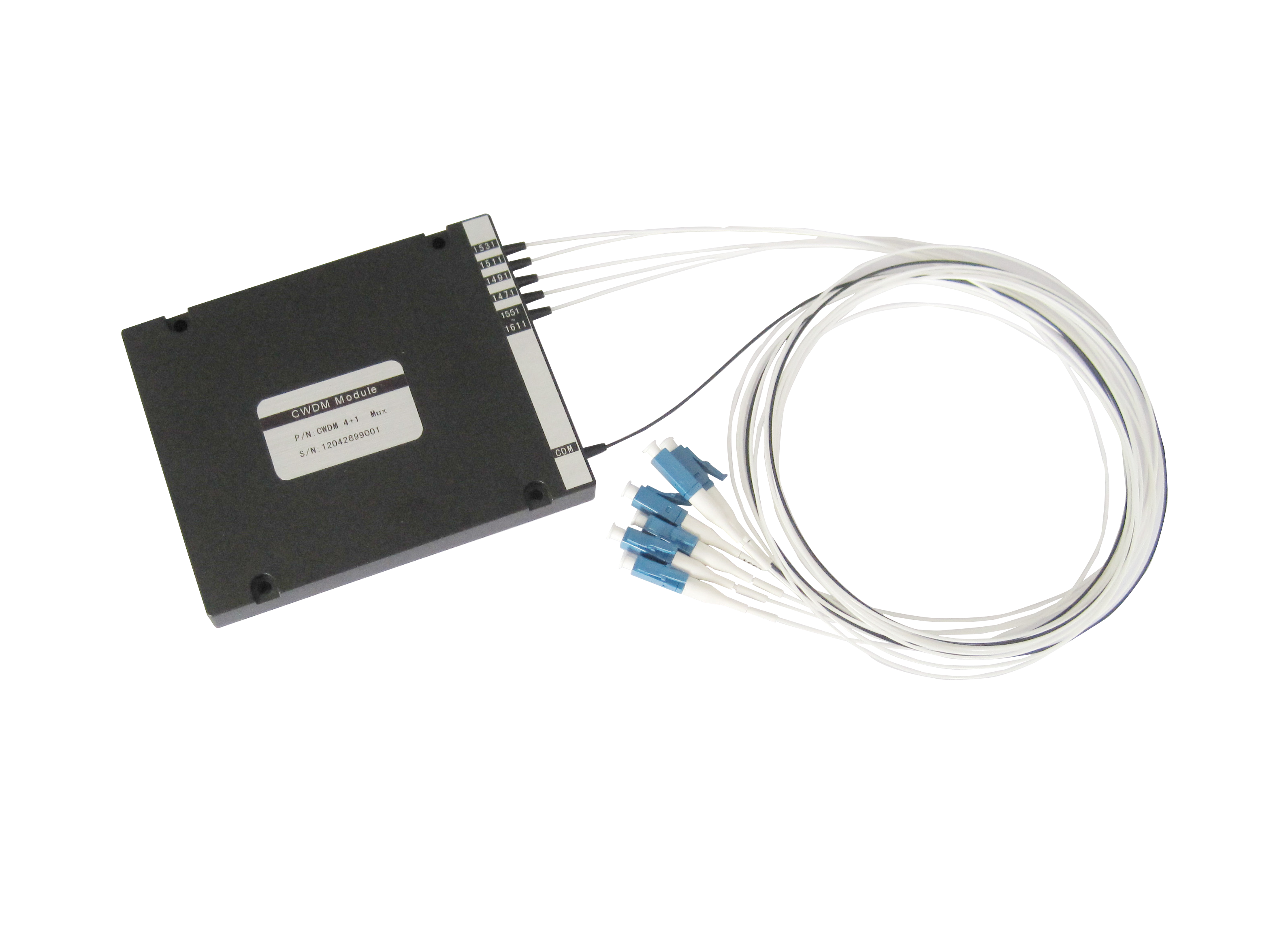
One Fiber, Ten Times the Capacity! A Deep Dive into Wavelength Division Multiplexers (WDM)
In the fiber optic communications industry, fiber infrastructure is one of the most valuable and expensive resources. Whether in telecom networks, data centers, or industrial optical transmission systems, the goal is always the same: transmit more data without installing more fiber.
Is there a technology that allows multiple signals to travel through a single optical fiber simultaneously?
The answer is Wavelength Division Multiplexing (WDM).
Simply put, WDM works like a multi-lane highway, allowing optical signals at different wavelengths to travel independently through the same fiber without interfering with each other. As a result, one fiber can carry the equivalent traffic of ten—or even dozens—of fibers.
What Is WDM?
WDM (Wavelength Division Multiplexing) is a technology that combines multiple optical signals with different wavelengths onto a single optical fiber for simultaneous transmission.
The transmission process is straightforward:
Multiple optical signals at different wavelengths
↓
WDM Multiplexer
↓
Single optical fiber
↓
WDM Demultiplexer
↓
Multiple independent optical signals
Because each wavelength occupies its own optical channel, all signals can travel simultaneously without interference, enabling true parallel optical communication.
Why Can WDM Dramatically Increase Fiber Capacity?
Imagine a conventional optical fiber carrying only:
- One 10G optical signal
With WDM, the same fiber can carry:
- 4 wavelengths = 40G
- 8 wavelengths = 80G
- 16 wavelengths = 160G
- 40 wavelengths = 400G
- 80 wavelengths = 800G
- Even more wavelengths can deliver multiple terabits per second (Tbps) of transmission capacity.
In other words:
Instead of adding more fibers, WDM adds more wavelengths.
This enables network operators to expand bandwidth without laying additional fiber cables, significantly reducing infrastructure costs.
Three Main Types of WDM
1. FWDM (Filter WDM)
FWDM is manufactured using Thin Film Filter (TFF) technology and offers several advantages:
- Low insertion loss
- High isolation
- Cost-effective
- Compact size
- Excellent long-term stability
Common wavelength combinations include:
- 1310/1490 nm
- 1310/1550 nm
- 1490/1550 nm
- 1310/1490/1550 nm
Typical applications include:
- PON networks
- FTTH
- CATV
- Fiber monitoring systems
2. CWDM (Coarse Wavelength Division Multiplexing)
CWDM features:
- 20 nm channel spacing
- Up to 18 wavelength channels
- Uncooled laser compatibility
- Lower deployment cost
- Simple network implementation
CWDM is widely used in:
- Enterprise networks
- Metropolitan Area Networks (MAN)
- Data centers
- 5G fronthaul
For medium-distance transmission, CWDM provides an excellent balance between performance and cost.
3. DWDM (Dense Wavelength Division Multiplexing)
DWDM supports much narrower channel spacing than CWDM, including:
- 100 GHz
- 50 GHz
- 25 GHz
or even smaller intervals.
Key advantages include:
- Ultra-high transmission capacity
- Long-distance communication
- Dozens to hundreds of wavelength channels
- Terabit-level bandwidth
Typical applications include:
- National backbone networks
- Submarine optical cable systems
- Cloud computing infrastructure
- AI computing clusters
Key Advantages of WDM
1. Maximizes Fiber Utilization
WDM significantly increases the capacity of existing fiber infrastructure without installing additional fiber cables.
2. Simplifies Network Expansion
As bandwidth demand grows, operators can simply add new wavelength channels instead of rebuilding the physical network.
3. Increases Network Capacity
Compared with traditional single-wavelength systems, WDM can multiply network bandwidth many times over.
4. Reduces Overall Deployment Costs
Although WDM components require an initial investment, they are far more economical than deploying new fiber infrastructure, reducing both installation and maintenance costs.
5. High Reliability
Passive WDM devices offer:
- No external power required
- No moving mechanical parts
- Long service life
- Excellent stability
- Minimal maintenance
These characteristics make WDM ideal for mission-critical communication networks.
Where Is WDM Used?
Today, WDM has become one of the core technologies in modern optical communications and is widely deployed in:
- Fiber-to-the-Home (FTTH)
- GPON / XGS-PON networks
- Data Center Interconnect (DCI)
- 5G fronthaul and backhaul
- Power utility communication systems
- CATV networks
- Fiber optic sensing systems
- AI data centers
- Cloud computing infrastructure
- Defense and scientific research networks
From metropolitan networks spanning tens of kilometers to backbone systems extending thousands of kilometers, WDM plays a critical role in high-capacity optical transmission.
How to Choose the Right WDM?
When selecting a WDM device, consider the following specifications:
- WDM type: FWDM, CWDM, or DWDM
- Operating wavelength: e.g., 1310 nm, 1490 nm, 1550 nm, or 1270–1610 nm
- Number of channels: 2, 4, 8, 16, 18, 40, 80, or more
- Insertion Loss (IL): Lower values improve transmission efficiency
- Isolation: Higher isolation minimizes channel crosstalk
- Return Loss (RL): Affects overall system stability
- Package type: Steel tube, ABS box, LGX module, or 19-inch rack
- Fiber type: Single-mode (SM), Polarization Maintaining (PM), etc.
- Operating temperature: Select according to indoor, outdoor, or industrial environments
Carefully matching these parameters helps ensure optimal system performance and long-term reliability.
Conclusion
As global bandwidth demand continues to grow, WDM has become a cornerstone technology for maximizing fiber utilization and expanding network capacity. By multiplexing multiple wavelengths onto a single optical fiber, WDM transforms traditional one-channel transmission into a high-capacity, multi-channel optical network.
Whether you choose FWDM for cost-effective passive optical networks, CWDM for metro and enterprise applications, or DWDM for ultra-high-capacity backbone networks, WDM delivers the scalability and efficiency required by today’s communication infrastructure.
For telecom operators, data centers, 5G deployments, and AI computing networks, selecting high-performance WDM components with low insertion loss, high isolation, and outstanding reliability is essential for building future-ready optical networks while minimizing infrastructure costs.
Comments are closed