


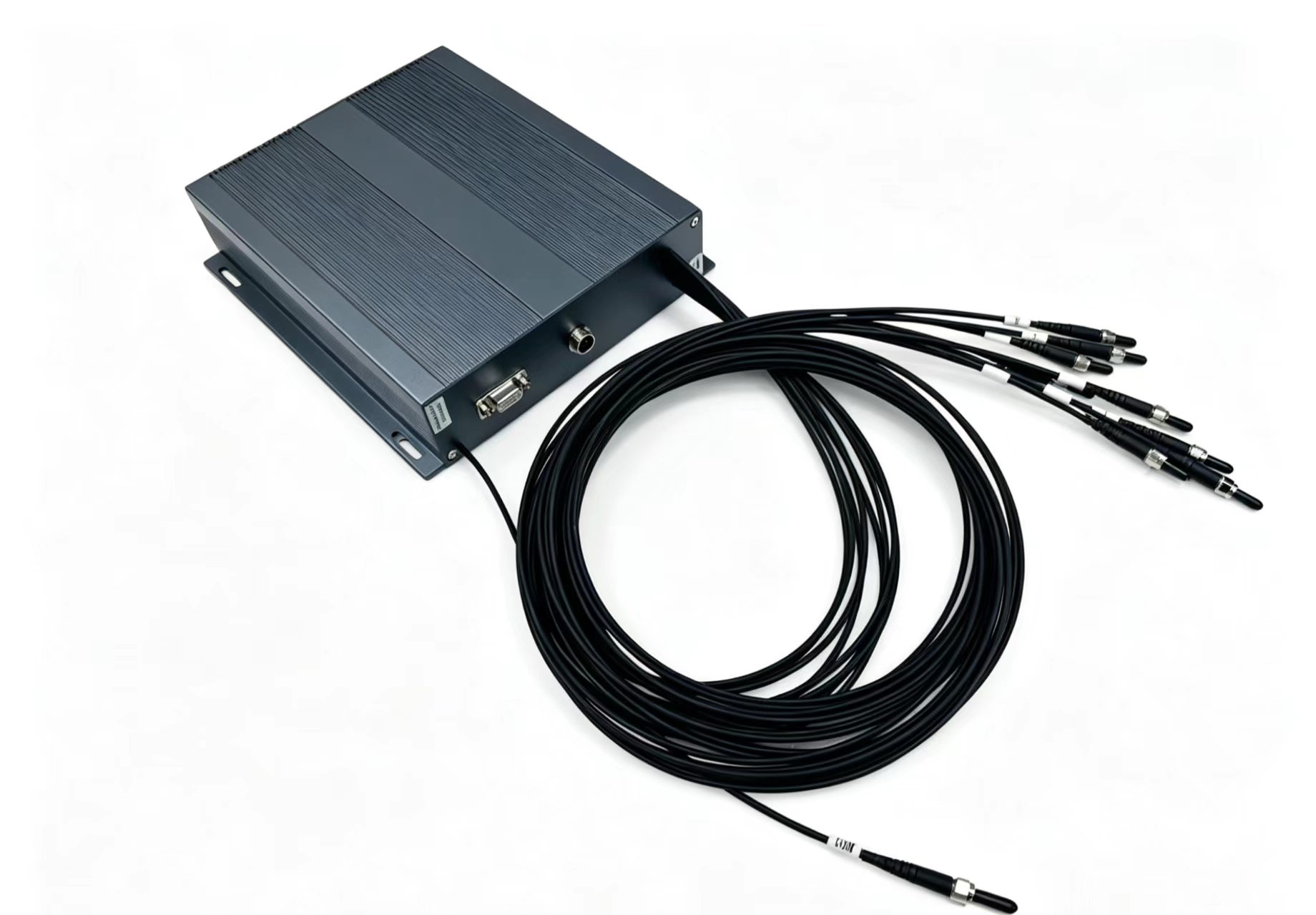
Can a 650nm Red Light POF Optical Switch Resist Electromagnetic Interference?
Introduction
In industrial automation, power systems, medical equipment, and communication testing environments, electromagnetic interference (EMI) can affect the stability and reliability of electronic signals.
When conventional electrical signal transmission is exposed to strong electromagnetic fields, problems such as signal distortion, transmission errors, and communication interruptions may occur.
A 650nm red-light POF (Plastic Optical Fiber) optical switch provides an optical-based switching solution that can help reduce these risks. Because it uses light rather than electrical current to transmit optical signals through the fiber, it offers excellent immunity to electromagnetic interference along the optical transmission path.
But can a 650nm red-light POF optical switch completely resist electromagnetic interference? Understanding its operating principle and system structure is important.
1. Why Is POF Optical Fiber Resistant to Electromagnetic Interference?
POF optical fiber transmits information using light instead of electrical signals.
Unlike copper cables, optical fibers do not rely on electrical current to carry signals. This gives them several important advantages:
- Immunity to EMI: Optical signals are not directly affected by electromagnetic fields.
- No electrical conduction: Plastic optical fibers are dielectric materials and do not conduct electricity.
- No ground loops: Optical transmission does not create electrical ground loops between connected devices.
- Reduced electrical noise: Optical signal transmission helps prevent electrical noise from coupling into the transmission path.
These characteristics make POF suitable for applications where electrical noise and electromagnetic interference are major concerns.
2. What Is the Role of 650nm Red Light?
A 650nm red-light source is commonly used in visible-light POF transmission systems.
The red light travels through the plastic optical fiber and carries the optical signal between connected devices.
The advantages of using 650nm red light include:
- Visible light makes optical path identification and basic troubleshooting easier.
- Compatible with suitable POF materials and optical components.
- Suitable for short-distance optical signal transmission.
- Provides a practical solution for industrial optical switching and signal routing applications.
It is important to understand that the 650nm wavelength itself does not create EMI immunity. The main advantage comes from using optical transmission instead of electrical signal transmission.
3. Can a 650nm POF Optical Switch Work in Strong EMI Environments?
Yes, a properly designed 650nm POF optical switching system can be used in environments with electromagnetic interference.
However, its overall EMI performance depends on more than the optical fiber.
A complete optical switch system generally includes three parts:
1. Optical transmission path
The POF fiber carries optical signals without conducting electrical current. Therefore, electromagnetic fields do not directly induce electrical noise in the optical transmission medium.
2. Optical switching mechanism
The switching mechanism controls the optical path between input and output ports. Its performance depends on the internal switching technology and mechanical or electronic design.
3. Electrical control system
The control board, power supply, communication interface, and driver circuits may still be affected by electromagnetic interference.
Therefore, although the optical transmission path is inherently immune to EMI, the entire optical switch should not automatically be considered EMI-proof.
For applications involving strong electromagnetic interference, shielding, grounding, power filtering, PCB layout, and communication interface protection should also be considered.
4. Typical Applications of 650nm POF Optical Switches
650nm POF optical switches can be considered for applications requiring reliable optical signal routing in electrically noisy environments.
Industrial Automation
Industrial production lines often contain motors, inverters, relays, and high-power electrical equipment. These devices can generate electromagnetic noise.
POF-based optical transmission can help isolate signal transmission paths from electrical interference.
Power System Monitoring
Substations and power distribution facilities contain high-voltage equipment and strong electromagnetic fields.
Optical transmission can provide electrical isolation between monitoring points and control equipment, helping improve signal transmission reliability.
Industrial Communication
In industrial communication systems, POF can be used for short-distance optical connections where electrical isolation and resistance to electromagnetic interference are important.
Testing and Measurement Equipment
Optical switches can route signals between multiple testing channels, reducing the need for repeated manual fiber connections.
For suitable 650nm POF systems, this can provide a practical solution for automated optical signal switching.
5. What Should You Consider When Selecting a 650nm POF Optical Switch?
When selecting an optical switch for an EMI-sensitive environment, wavelength compatibility alone is not enough.
Consider the following factors:
- Wavelength: Confirm that the switch supports 650nm operation.
- Fiber type: Ensure compatibility with the required POF fiber specification.
- Optical performance: Evaluate insertion loss, repeatability, and channel stability.
- Switching configuration: Select a suitable 1×2, 1×4, or other channel configuration according to the application.
- Control interface: Check whether RS232, TTL, USB, or another control method is required.
- EMC requirements: Evaluate the complete device against the electromagnetic compatibility requirements of the installation environment.
For demanding industrial applications, it is advisable to confirm the actual EMI test requirements with the manufacturer before making a final selection.
6. Technical Specifications of 650nm Red Light POF Optical Switch
| Parameter | Parameter Values |
| Model | XH-OSW-1X8 |
| Insertion Loss | ≤1.5dB(Excluding the length loss
of the fiber itself) |
| Wavelength Range | 400~850 nm |
| Fiber Type | 2000UM |
| Return Loss | ≥30 dB |
| Crosstalk | ≥ 50 dB |
| Repeatability | ≤0.1 dB |
| Lifetime | >107 |
| Switching Time | ≤30 ms (Adjacent channel) |
| Connector | SMA905 |
| Control Mode | RS-232 |
| Working Power Supply | 5V/2000 mA |
| Product Sze | 220 x 204 x 48 |
| Operating Temperature | -20 ℃ to +70 ℃ |
| Storage Temperature | -40 ℃ to +85 ℃ |
Conclusion
A 650nm red-light POF optical switch can provide an effective solution for optical signal routing in environments where electromagnetic interference is a concern.
Its main advantage comes from the dielectric nature of plastic optical fiber and the use of light for signal transmission, which eliminates electromagnetic coupling into the optical transmission medium.
However, the optical fiber’s immunity does not mean that the complete switching device is immune to all electromagnetic interference. The electronic control system and power supply must also be properly designed and tested.
Choosing the right POF optical switch requires considering not only wavelength and switching configuration, but also the electromagnetic compatibility requirements of the complete system.
Comments are closed