


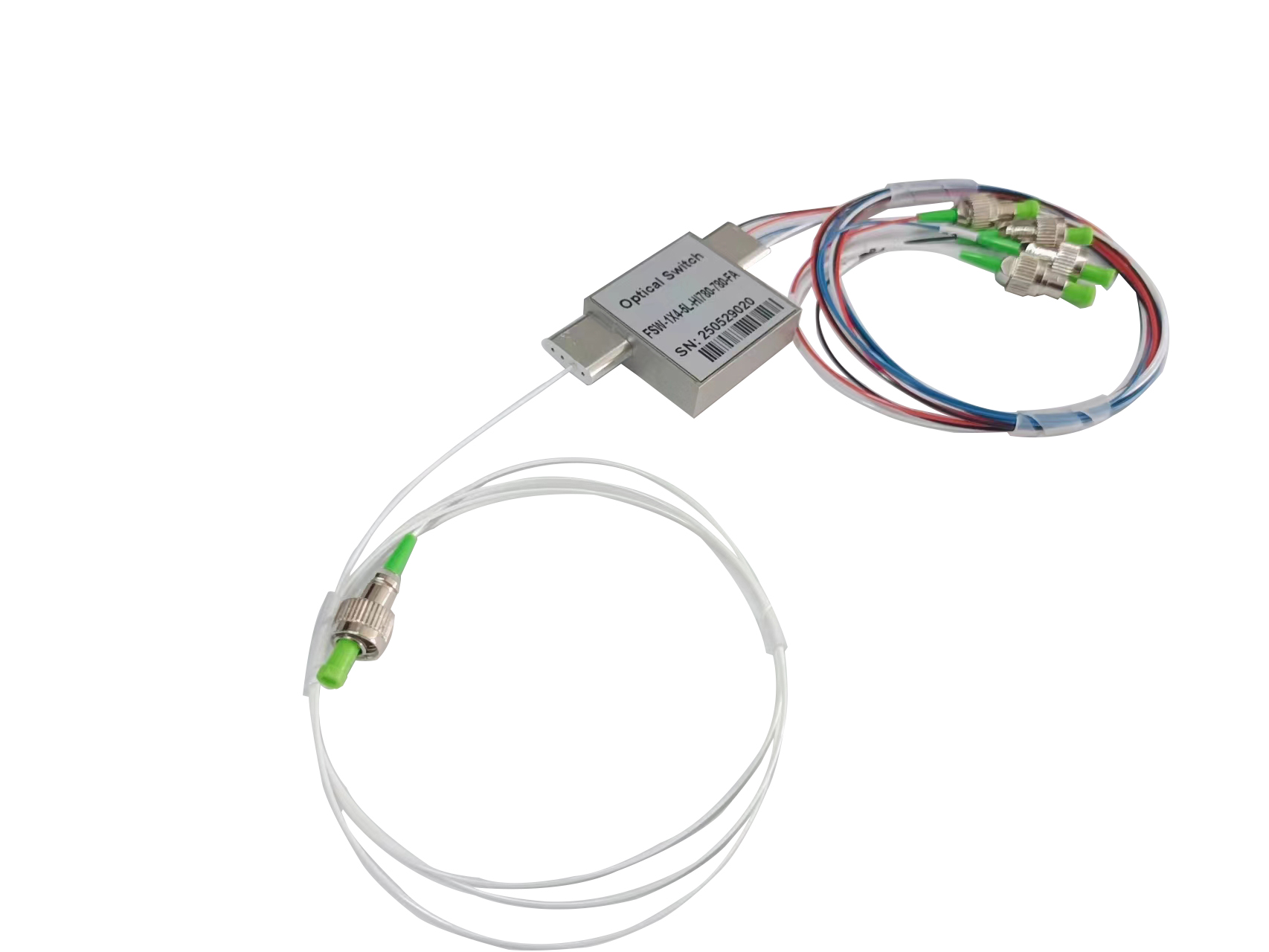
How to Choose an Optical Switch: Comprehensive Selection Guide
Introduction
With the rapid development of optical communication networks, data centers, fiber optic sensing systems, fiber lasers, and automated test platforms, optical switch have become essential components for optical path routing, network protection, and resource sharing.
However, with various types of optical switches available on the market—including mechanical optical switches, MEMS optical switches, polarization-maintaining optical switches, and high-power optical switches—selecting the most suitable solution can be challenging.
This article outlines the key factors to consider when choosing an optical switch for your application.
1. Define Your Application Requirements
The first step in selecting an optical switch is understanding the intended application.
Optical Network Protection
Typical applications:
- Optical Line Protection (OLP)
- Fiber link redundancy
- Telecommunication networks
Recommended products:
- 1×2 Mechanical Optical Switch
- Optical Line Protection Switch
Key considerations:
- Switching speed
- Operational lifetime
- Long-term reliability
Fiber Optic Testing and Measurement
Typical applications:
- Automated Test Equipment (ATE)
- Optical component testing
- Laboratory measurement systems
Recommended products:
Key considerations:
- Number of channels
- Repeatability
- Insertion loss
Fiber Lasers and Scientific Research
Typical applications:
- Polarization-maintaining systems
- Laser routing and switching
- Fiber optic sensing
Recommended products:
Key considerations:
- Extinction ratio
- Power handling capability
- Polarization-maintaining performance
2. Choose the Appropriate Optical Switch Technology
Mechanical Optical Switch
Working principle:
Mechanical optical switches use precision mechanical movement to align optical fibers and redirect optical signals.
Advantages:
- Ultra-low insertion loss
- High return loss
- Excellent isolation
- Proven reliability
Typical applications:
- Optical communication systems
- Test and measurement equipment
- Network protection systems
MEMS Optical Switch
Working principle:
MEMS optical switches use micro-electromechanical mirrors to redirect optical beams.
Advantages:
- Large port count scalability
- Fast switching speed
- Easy system integration
Typical applications:
- Data centers
- Optical Cross Connects (OXC)
- Dynamic optical network management
Polarization-Maintaining Optical Switch
Working principle:
PM optical switches maintain the polarization state of light during switching.
Advantages:
- Preserves polarization orientation
- Ideal for polarization-sensitive applications
Typical applications:
- Fiber optic gyroscopes
- Coherent communication systems
- Fiber laser systems
3. Evaluate Key Technical Specifications
1. Insertion Loss
Lower insertion loss results in reduced signal attenuation.
Typical requirements:
- Standard applications: ≤ 1.0 dB
- High-performance applications: ≤ 0.8 dB
Lower insertion loss improves overall system efficiency.
2. Return Loss
Return loss indicates the amount of reflected optical power.
Recommended values:
- ≥ 50 dB
- Even higher values can be achieved with APC connectors
Higher return loss contributes to better system stability.
3. Crosstalk
Crosstalk measures optical leakage into non-selected channels.
Recommended values:
- ≥ 55 dB
Higher isolation ensures superior signal integrity.
4. Switching Time
Required switching speed depends on the application:
- Network protection: < 10 ms
- Automated testing: 10–30 ms
- MEMS switches: typically faster
5. Operational Lifetime
High-quality mechanical optical switches typically support:
- More than 10 million switching cycles
This is particularly important for systems requiring long-term operation.
4. Select the Correct Operating Wavelength
Common operating wavelengths include:
| Wavelength | Typical Application |
|---|---|
| 780 nm | Biomedical systems |
| 850 nm | Data communications |
| 980 nm | EDFA pumping |
| 1064 nm | Fiber lasers |
| 1310 nm | Optical communication networks |
| 1550 nm | Long-haul communications |
| Above 2000 nm | Specialty fiber applications |
Ensure that the optical switch wavelength range matches your system requirements.
5. Choose the Appropriate Fiber Type
Common fiber types include:
Single-Mode Fiber (SMF)
Suitable for:
- Optical communication networks
- Data centers
Multimode Fiber (MMF)
Suitable for:
- Short-distance transmission
- Local area networks (LAN)
Polarization-Maintaining Fiber (PM Fiber)
Suitable for:
- Fiber laser systems
- Polarization-sensitive applications
Large-Core Fiber
Suitable for:
- High-power lasers
- Industrial laser processing systems
6. Consider Control Interface Requirements
Modern optical switches commonly support multiple control interfaces, including:
- TTL
- RS232
- USB
- Ethernet (RJ45)
- GPIB
- Front-panel push-button control
For remote operation and automated testing, RS232, USB, or Ethernet interfaces are typically recommended.
7. Select a Reliable Optical Switch Supplier
A qualified optical switch manufacturer should provide:
- Extensive R&D experience
- Strict quality control systems
- Stable long-term supply capability
- Responsive technical support
- Custom design and OEM/ODM services
For telecom-grade and industrial applications, reliability is often more important than price alone.
Conclusion
Choosing the right optical switch involves much more than selecting the required number of ports. Factors such as application requirements, operating wavelength, fiber type, insertion loss, switching speed, operational lifetime, and control interface should all be carefully evaluated.
For most communication and testing applications, mechanical optical switches offer an excellent balance of performance and cost-effectiveness. For high-port-count optical routing, MEMS optical switches are often the preferred solution. For laser systems and polarization-sensitive applications, PM optical switches and high-power optical switches provide the best performance.
Properly selected optical switch can significantly enhance system performance, reliability, and long-term operational stability.
Comments are closed