


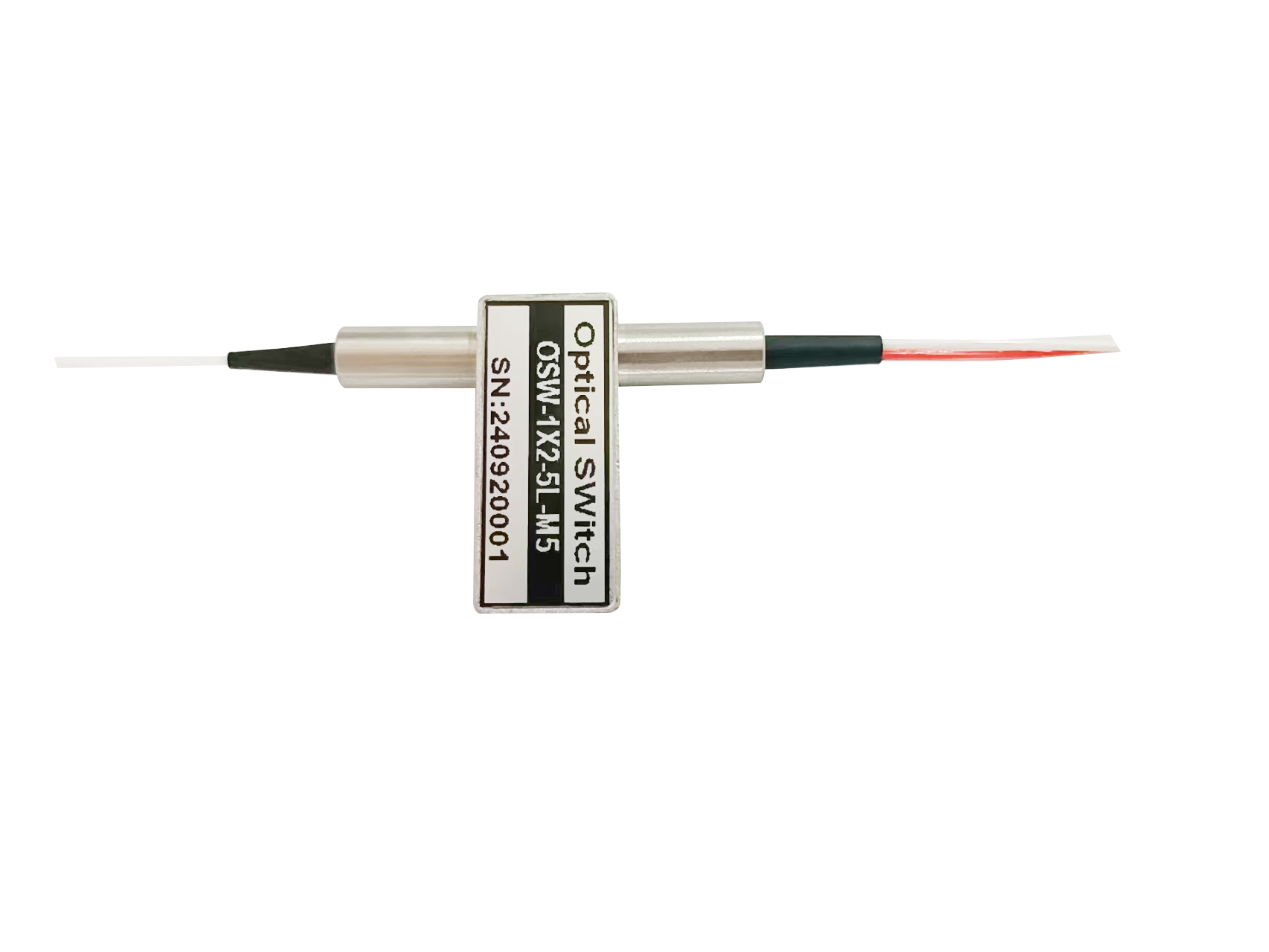
One Optical Signal, Two Paths — A Compact Switching Solution
In many optical systems, there is a simple but important requirement: one optical signal needs to be switched between two different optical paths.
For large optical systems, adding a switching component may not be a major concern. But for compact test instruments, sensing equipment, photonics devices, and research systems, space, reliability, and optical performance can all be important design considerations.
This is where a compact 1×2 mechanical optical switch can provide a practical solution.
What Is 1×2 Optical Switch?
1×2 optical switch has one common optical port and two selectable optical paths.
It allows the optical signal to be directed to either Path 1 or Path 2 depending on the switching state.
The basic configuration is:
Input → Output 1
or
Input → Output 2
This simple structure makes the 1×2 optical switch suitable for applications that require optical path selection, testing, monitoring, or switching between two optical channels.
Why Choose a Mini Optical Switch?
As optical equipment becomes smaller and more integrated, the available space inside the device can be limited.
A mini optical switch can help equipment designers achieve optical switching without adding a large component to the system.
Key advantages include:
- Compact footprint for space-constrained equipment
- Two selectable optical paths
- Mechanical switching technology
- Easy integration into optical instruments
- Suitable for automated optical testing and monitoring
- Flexible configurations for different applications
For OEM equipment manufacturers, a compact optical switch can also make it easier to optimize the internal layout of the optical system.
Where Can a 1×2 Mini Optical Switch Be Used?
1. Optical Test Equipment
Optical testing is one of the most common applications.
A test instrument may need to switch an optical signal between the device under test and a reference or measurement path.
For example:
Optical Source → 1×2 Switch → DUT
or
Optical Source → 1×2 Switch → Reference Path
This allows the same optical source or measurement system to be used for different test paths.
2. Optical Monitoring
A 1×2 optical switch can also be used when an optical signal needs to be selectively connected to a monitoring device.
Under normal conditions, the signal can remain on the primary path. When monitoring is required, the switch can select the measurement path.
This can be useful in optical network monitoring and equipment-level signal testing.
3. Fiber Optic Sensing
Fiber sensing systems may require switching between different optical paths during measurement, calibration, or system testing.
A compact 1×2 switch can provide a simple method for selecting between two optical channels without significantly increasing the size of the sensing system.
4. Photonics Research
Research laboratories often use customized optical setups where different optical components need to be connected or disconnected during experiments.
A small mechanical optical switch can provide flexible optical path selection while helping keep the experimental setup compact.
5. Laser and Optical Instruments
Laser systems and optical instruments may also require switching between a working path and a measurement or reference path.
In these applications, the optical switch needs to be selected according to parameters such as wavelength, insertion loss, optical power, switching speed, and fiber type.
Mini Size Can Matter in Equipment Design
For a standalone optical component, size may not always be a major concern.
For an OEM optical instrument, however, every component occupies valuable internal space.
A smaller optical switch can provide several design benefits:
Smaller optical assembly → More flexible internal layout → Easier equipment integration
This can be particularly important for portable instruments, compact test systems, and other equipment with limited internal space.
Non-Latching vs. Latching Optical Switches
When selecting a mechanical optical switch, the switching mechanism is another important consideration.
A non-latching optical switch typically maintains its selected optical path only while the required drive condition is applied. When the drive signal is removed, the switch returns to its default state.
A latching optical switch, in contrast, maintains its switching state after the drive signal is removed.
The appropriate configuration depends on the equipment design and control requirements.
For systems where the optical path needs to return to a defined default position, a non-latching configuration can be useful.
What Should You Consider When Selecting a 1×2 Optical Switch?
Before selecting a mini 1×2 optical switch, engineers should consider several technical parameters.
Wavelength
The switch should support the operating wavelength of the system, such as 780 nm, 850 nm, 1310 nm, or 1550 nm.
Fiber Type
The required fiber type may include:
- Single-mode fiber
- Multimode fiber
- Polarization-maintaining fiber
- Other application-specific fibers
Insertion Loss
Low insertion loss helps minimize the optical power loss introduced by the switching component.
Return Loss
A higher return loss can help reduce unwanted reflected optical signals in sensitive systems.
Switching Time
For automated testing and dynamic optical systems, switching time can be an important factor.
Switching Mode
Engineers should determine whether a latching or non-latching configuration is more appropriate for the system.
Package Size
For compact equipment, the physical dimensions and mounting method should be considered early in the system design.
A Small Component for a Practical Optical Switching Requirement
Not every application requires a large multi-channel optical switching platform.
Sometimes, the requirement is much simpler:
One optical signal. Two optical paths. One compact switching solution.
A 1×2 Mini Mechanical Optical Switch can provide a practical way to integrate optical path selection into compact test equipment, optical monitoring systems, fiber sensing platforms, photonics instruments, and research systems.
For equipment manufacturers, the right optical switch is not only about the switching function. Size, optical performance, switching mode, reliability, and ease of integration can all affect the final system design.
Conclusion
As optical equipment continues to become smaller and more integrated, compact optical switching components can play an important role in system design.
A 1×2 mini mechanical optical switch provides a straightforward solution for selecting between two optical paths while maintaining a compact form factor.
Whether used for optical testing, monitoring, sensing, photonics research, or equipment integration, it can be a useful building block for systems that need simple and reliable optical path switching.
Comments are closed