


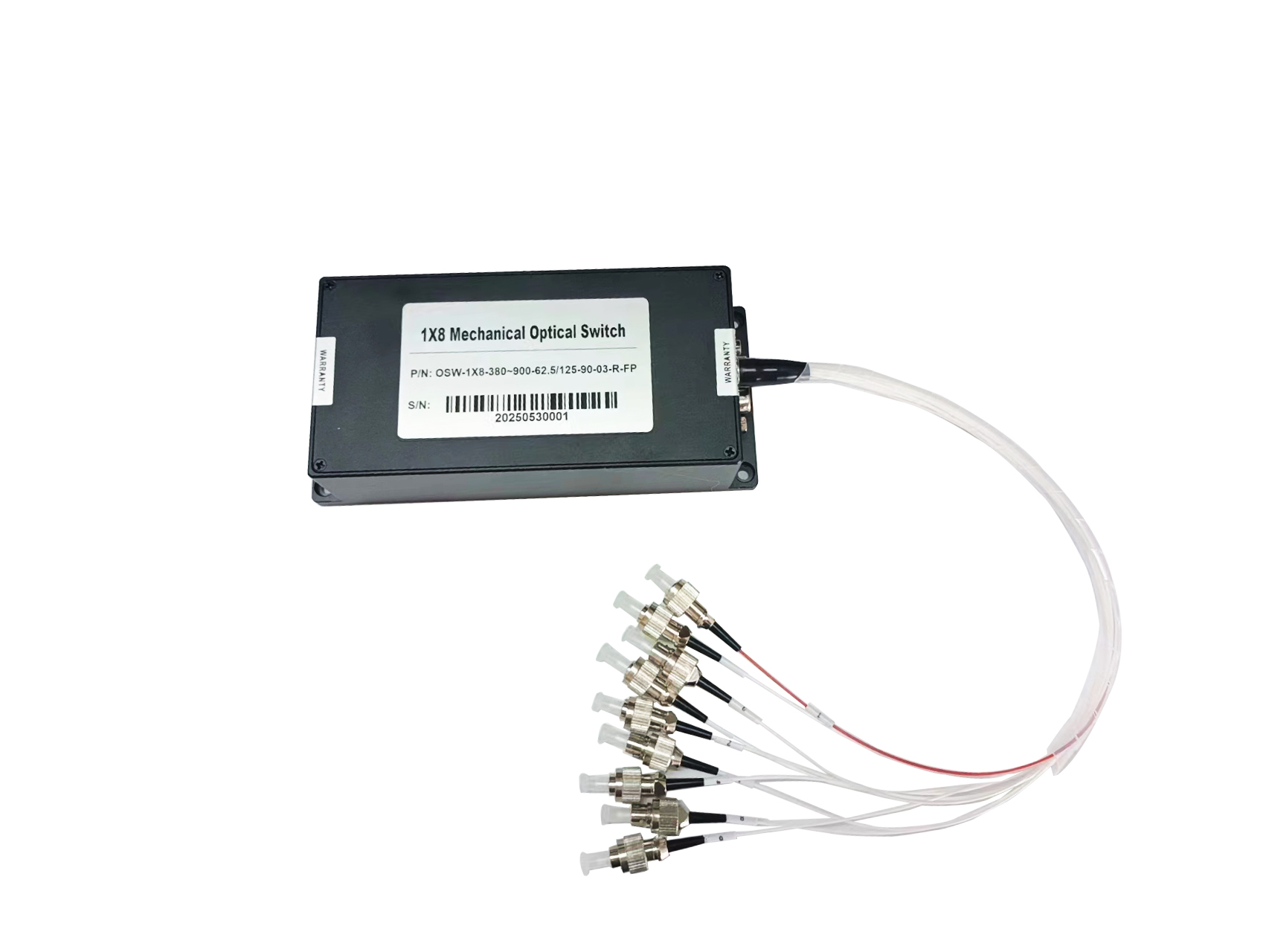
How to Achieve Reliable Optical Switch 532nm Multimode Fiber System
In laser processing, machine vision, biomedical equipment, scientific research, and fiber sensing applications, 532nm green lasers are widely used because of their high visibility and unique optical properties.
However, when 532nm laser light needs to be transmitted through multimode fiber (MMF) and switched between different optical paths, a standard optical switch designed for telecom wavelengths may not provide the required performance.
So, how can you achieve stable, low-loss, and reliable optical switching in a 532nm multimode fiber system?
The answer involves more than simply selecting an optical switch. Factors such as operating wavelength, fiber type, core diameter, numerical aperture, beam size, coupling efficiency, and optical power must all be considered.
1. Why Is Optical Switch at 532nm More Challenging?
Most conventional optical switches are primarily designed for telecom wavelengths such as 1310nm and 1550nm, while 532nm belongs to the visible spectrum.
This difference in wavelength can directly affect several critical optical parameters.
First, the optical coatings inside the switch must be optimized for 532nm. If the collimators, lenses, or other optical components are designed for telecom wavelengths, their transmission and reflection characteristics may not be suitable for green laser applications, potentially resulting in higher insertion loss.
Second, the beam characteristics of a 532nm laser can also affect fiber coupling efficiency.
Although multimode fiber generally has a larger core diameter and greater alignment tolerance than single-mode fiber, factors such as:
- Fiber core diameter
- Numerical aperture (NA)
- Beam divergence
- Input beam size
can all influence coupling efficiency and output power stability after switching.
Therefore, a reliable 532nm multimode optical switch is not simply a standard telecom optical switch operating at a different wavelength.
2. Choose an Optical Design Optimized for 532nm
To achieve reliable switching, the internal optical system must be specifically designed or optimized for the 532nm operating wavelength.
Several factors should be considered.
Optical Coating Compatibility
The lenses, collimators, and other optical components inside the optical switch should use anti-reflection coatings optimized for 532nm.
Proper AR coatings can reduce reflection losses at optical interfaces and improve overall transmission efficiency.
If the coating is not optimized for the operating wavelength, potential problems may include:
- Higher insertion loss
- Optical power fluctuations
- Increased back reflection
- Reduced long-term stability
Therefore, when selecting an optical switch, it is important to confirm whether it is specifically designed or customized for 532nm operation.
3. Multimode Fiber Parameters Must Be Properly Matched
Different multimode fibers have different core diameters and numerical apertures.
Common multimode fiber sizes may include:
- 50/125 μm
- 62.5/125 μm
- 105/125 μm
- 200 μm
- 400 μm
For different fiber core sizes, the internal collimation system and optical beam transmission design may need to be optimized accordingly.
If the optical system is not properly matched, problems may occur.
For example:
The coupling efficiency at the input may be high, while the output power is significantly reduced.
Or:
Different switching channels may show significant differences in insertion loss.
Therefore, when customizing a 532nm multimode optical switch, the following parameters should normally be confirmed:
- Fiber core diameter
- Fiber cladding diameter
- Numerical aperture (NA)
- Operating wavelength
- Fiber length
- Connector type or bare fiber requirements
These parameters can directly affect the final optical design and switching performance.
4. Mechanical Optical Switches Can Be a Reliable Solution
For many 532nm multimode fiber systems, a mechanical optical switch can be a practical and reliable solution.
Its basic operating principle is to use a precision mechanical actuator to physically switch the input optical path between different output ports.
For example:
1×2 Optical Switch
A 1×2 optical switch can direct one 532nm optical signal to one of two output ports.
1×4 Optical Switch
A 1×4 optical switch can route one input signal to one of four different optical paths.
These configurations can be suitable for applications such as:
- Laser testing systems
- Optical research platforms
- Multi-channel measurement equipment
- Biomedical instruments
- Laser scanning systems
- Fiber sensing systems
Compared with more complex optical routing methods, mechanical optical switches can offer straightforward control and reliable switching performance.
5. How Can Insertion Loss Be Reduced?
Insertion loss is one of the most important parameters when evaluating an optical switch.
In a 532nm multimode fiber system, reducing insertion loss typically requires optimization in several areas.
High-Precision Fiber Collimation
By effectively collimating the light emitted from the multimode fiber, beam divergence during free-space transmission inside the switch can be reduced.
A properly designed collimation system can improve coupling efficiency when the beam is coupled back into the output fiber.
Precise Optical Alignment
The relative positions of the fibers, lenses, and mechanical switching components must be maintained with high precision.
If the mechanical positioning repeatability is insufficient, the output optical power may vary after each switching operation.
For systems that require frequent switching, repeatability can be just as important as low insertion loss.
Optimized Beam Size
If the beam size is too large, it may not be efficiently coupled into the output fiber.
If the beam size is too small, the system may become more sensitive to alignment errors.
Therefore, the beam size should be optimized according to the fiber core diameter and NA.
6. Optical Power Must Also Be Considered
For low-power light sources, optical switch selection may mainly focus on parameters such as insertion loss, isolation, and switching speed.
However, if the 532nm system uses a laser source, especially a higher-power green laser, the optical power handling capability of the switch must also be carefully evaluated.
Higher optical power may introduce risks such as:
- Optical coating damage
- Fiber end-face damage
- Adhesive degradation
- Localized heating
- Reduced optical component performance
Therefore, before selecting a 532nm multimode optical switch, it is important to confirm:
What is the maximum input optical power?
Typical power levels may include:
- mW-level power
- Hundreds of mW
- More than 1 W
- Higher-power applications
Different power levels may require different internal optical designs and packaging solutions.
For high-power applications, optical components with higher damage thresholds and optimized fiber collimation designs may be required.
7. Latching or Non-Latching?
The switching mechanism should also be selected according to the requirements of the overall system.
Latching Optical Switch
A latching optical switch does not require continuous electrical power to maintain its switched state after the switching operation is completed.
Its advantages may include:
- Lower power consumption
- Suitable for maintaining a selected channel for extended periods
- Reduced heat generation from continuous power
- Suitable for power-sensitive systems
Non-Latching Optical Switch
A non-latching optical switch requires continuous power to maintain a specific switching state.
When power is removed, the switch normally returns to its default position.
This type of switch can be suitable for:
- Systems requiring automatic reset
- Safety protection systems
- Applications with specific control logic
Therefore, the choice between latching and non-latching operation should be based on the control requirements of the complete system.
8. Long-Term Reliability Depends on Switching Repeatability
The reliability of an optical switch is not determined simply by whether it can successfully switch between channels.
For a 532nm fiber system operating over an extended period, a more important question is:
Will the optical power remain stable after a large number of switching cycles?
Important performance factors include:
- Switching lifetime
- Repeatability
- Insertion loss stability
- Channel-to-channel consistency
- Operating temperature tolerance
- Vibration resistance
In industrial or automated testing systems, an optical switch may perform thousands or even tens of thousands of switching operations per day.
If the mechanical positioning accuracy gradually degrades, the switch may still operate mechanically while the output optical power becomes unstable.
Therefore, a high-reliability design requires not only a stable actuator but also precise mechanical positioning and long-term repeatability testing.
9. How to Select the Right 532nm Multimode Optical Switch
Before purchasing or customizing a 532nm multimode optical switch, it is recommended to confirm the following parameters:
| Parameter | Information to Confirm |
|---|---|
| Operating Wavelength | 532nm |
| Fiber Type | Multimode Fiber (MMF) |
| Fiber Core Diameter | 50 μm, 62.5 μm, 105 μm, 200 μm, 400 μm, etc. |
| Numerical Aperture | NA value |
| Switch Configuration | 1×2, 1×4, 1×8, or other |
| Switching Type | Latching or Non-Latching |
| Optical Power | Maximum input optical power |
| Control Interface | TTL, USB, RS232, or other |
| Packaging | Bare fiber, FC/APC, SMA905, or customized |
| Environmental Requirements | Operating temperature, vibration, and industrial requirements |
Providing complete application parameters can help manufacturers develop a more suitable optical and mechanical switching solution.
Conclusion: Reliable 532nm Optical Switching Requires System-Level Matching
Achieving reliable optical switching in a 532nm multimode fiber system is not simply a matter of selecting a standard optical switch.
Key factors affecting system performance include:
- Optical components optimized for 532nm
- Proper matching of multimode fiber core size and NA
- Low-loss optical design
- High-repeatability mechanical positioning
- Appropriate optical power handling capability
- The right choice between latching and non-latching operation
- Long-term switching reliability
For applications in scientific research, laser systems, optical measurement, and industrial automation, a properly designed 532nm multimode optical switch can provide stable and reliable switching between multiple optical paths, reduce manual operation, and improve system automation.
Comments are closed