


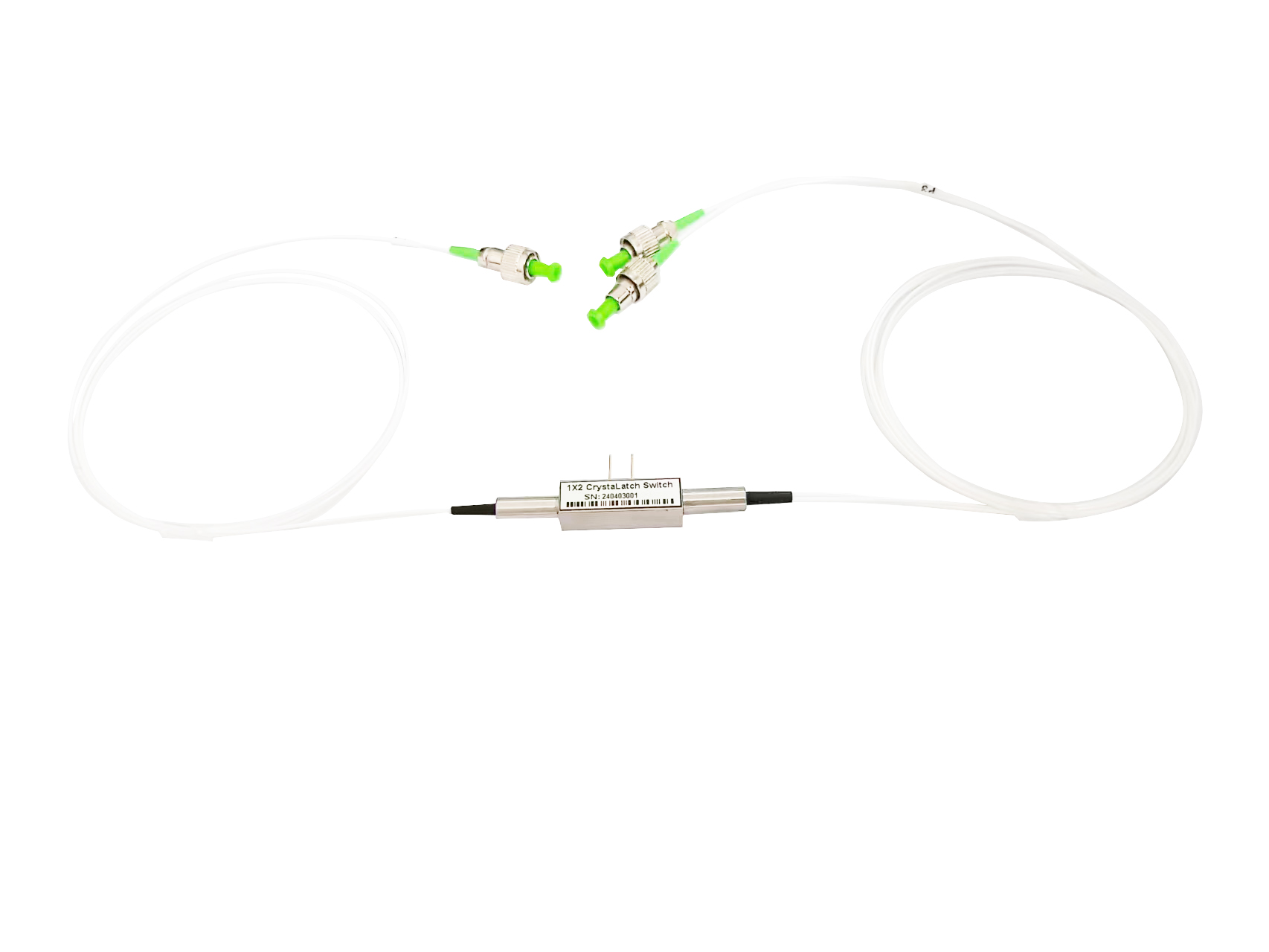
Why Choose a Magneto Optical Switch for Building a High-Reliability Optical Network?
As data centers, fiber-optic transmission networks, fiber sensing systems, test platforms, and other critical communication infrastructures continue to demand greater reliability, optical switching reliability has become increasingly important.
When a primary fiber link fails, equipment experiences an abnormal condition, or an optical path needs to be rerouted, the ability to switch the optical signal quickly and reliably to a backup path can directly affect the continuity of the entire system.
Among various optical switching technologies, magneto optical switches (MOS) offer an attractive solution for high-reliability optical networks. With their unique operating principle, reduced dependence on mechanical movement, long-term stability, and reliable switching performance, they can play an important role in critical optical network applications.
So, why choose a magneto-optical switch when building a high-reliability optical network?
1. What Is a Magneto-Optical Switch?
Magneto optical switch is an optical switching device that uses the magneto-optical effect to control or change the transmission path of an optical signal.
Unlike conventional mechanical optical switches, a magneto-optical switch does not rely on continuously moving optical fibers or complex mechanical components to redirect the optical path. Instead, it uses magnetic control to change the optical properties or state of a magneto-optical element, allowing the optical signal to be directed between different transmission paths.
In simple terms:
Mechanical optical switches change the optical path through physical movement, while magneto-optical switches use magnetic control to manipulate the optical path.
This operating principle offers an important advantage:
Reduced mechanical movement can help minimize wear and improve long-term operational reliability.
2. Reduced Mechanical Movement Helps Minimize Wear
Traditional mechanical optical switches may rely on moving components to change the optical path. Depending on the design, repeated operation can involve mechanical movement of fibers, mirrors, prisms, or other optical elements.
Over long periods of operation, mechanical systems may be affected by:
- Friction
- Mechanical wear
- Component fatigue
- Positioning deviations
- Vibration and environmental disturbances
Magneto-optical switches use magnetic control and magneto-optical effects to achieve switching, reducing dependence on complex mechanical movement.
This means:
Less mechanical movement can mean fewer opportunities for mechanical wear and fatigue.
For systems that require long-term operation or frequent switching, this can be a significant advantage.
Typical applications include:
- Optical network protection systems
- Automatic backup links
- Data center optical networks
- Fiber-optic sensing systems
- Automated test systems
- Industrial communication networks
In these applications, users expect the optical switching system to maintain stable performance over an extended operating period.
3. Designed for Long-Term and Repeated Switching
In many optical network applications, switching is not a one-time operation.
For example, an automatic protection system may need to:
- Continuously monitor the primary optical link.
- Detect a fiber failure or abnormal condition.
- Automatically switch the optical signal to a backup path.
- Switch back when the primary link is restored.
- Repeat this process throughout the lifetime of the system.
For this reason, switching lifetime and repeatability are critical factors.
Because magneto-optical switching reduces dependence on conventional mechanical movement, it can be well suited for applications that require long-term automated operation and repeated switching.
For unattended systems, the key question is often not simply:
“Can the switch work today?”
Instead, it is:
“Can the switch continue to operate reliably after long-term use and repeated switching?”
This is where magneto-optical switching technology can provide important value.
4. Improved Protection for Critical Fiber Links
For critical communication networks, the biggest problem is not simply that a link fails.
The real challenge is:
How quickly and reliably can communication be restored after a failure occurs?
A magneto-optical switch can be integrated into an optical protection system to enable automatic switching between primary and backup fiber links.
A typical protection system may include:
- Primary optical link
- Backup optical link
- Optical power monitoring
- Control system
- Magneto-optical switch
Under normal conditions, the optical signal travels through the primary link.
If the system detects:
- Fiber breakage
- Sudden optical power loss
- Equipment failure
- Significant degradation in link quality
The controller can send a switching command to redirect the optical signal to the backup path.
This helps transform a network architecture from:
Single-path operation
to:
Redundant primary-and-backup optical protection.
For critical communications and data transmission systems, this type of automatic protection can significantly reduce the risk of service interruption caused by a single-point failure.
5. Better Adaptability for Vibration and Long-Term Operation
Optical networks operating in laboratories are usually installed in relatively stable environments.
However, real-world applications may involve more demanding conditions, such as:
- Vibration
- Temperature variations
- Continuous operation
- Industrial environments
- Outdoor installation
- Long-term unattended operation
Mechanical systems may be affected by repeated movement, vibration, or long-term structural fatigue.
By reducing dependence on complex mechanical movement, magneto-optical switches can offer advantages in applications where long-term reliability is a major concern.
They can therefore be considered for applications such as:
- Industrial communication systems
- Railway and transportation networks
- Power utility communication
- Aerospace and defense systems
- Fiber-optic sensing networks
- Outdoor communication equipment
Of course, actual environmental performance should always be evaluated according to the specific product’s temperature range, packaging, reliability testing, and application requirements.
6. Stable Optical Performance Is Equally Important
For an optical network, it is not enough for a switch to simply change the optical path.
The more important question is:
Can the optical signal continue to transmit stably after switching?
When selecting a high-reliability magneto-optical switch, several key optical parameters should be considered.
Low Insertion Loss
Lower insertion loss means less optical power is lost when the signal passes through the switch.
This is especially important for long-distance transmission systems or applications with a limited optical power budget.
Low Crosstalk
In multi-port switching systems, the selected optical path should be clearly isolated from unwanted paths.
Low crosstalk helps reduce signal interference and maintain transmission quality.
High Repeatability
The optical performance should remain as consistent as possible after every switching operation.
For example, if the insertion loss is 0.5 dB during the first switching operation but gradually increases to 1.5 dB after repeated switching, the long-term stability of the system may be affected.
Therefore, high-reliability optical networks require:
Consistent switching performance and stable optical characteristics over repeated operating cycles.
High Return Loss
High return loss helps reduce optical reflections that could affect lasers, optical amplifiers, and other sensitive components.
Reflection control can be particularly important in high-speed communication and precision optical systems.
7. Where Are Magneto-Optical Switches Used?
1. Optical Network Protection
Magneto-optical switches can be used to switch automatically between primary and backup fiber links.
When the primary path fails, the system can switch to the backup path to improve overall network availability.
2. Data Center Optical Networks
As data centers continue to grow, network interruptions can affect critical services.
Magneto-optical switches can be used for:
- Primary and backup optical path switching
- Network redundancy
- Optical signal routing
- Optical link maintenance and protection
This helps improve the continuity and resilience of the network.
3. Fiber-Optic Sensing Systems
Distributed fiber sensing, optical monitoring, and multi-point measurement systems often require switching between different sensing paths.
Magneto-optical switches can support automated optical path management and long-term system operation.
4. Test and Measurement Systems
Automated optical test platforms may need to repeatedly switch between different devices or measurement channels.
When a system performs large numbers of switching operations, switching reliability and repeatability become critical factors.
5. Aerospace, Defense, and Industrial Control
These applications often place high demands on system stability and long-term reliability.
In complex operating environments, reducing reliance on mechanical movement can help improve the reliability of the overall optical switching system.
8. Magneto-Optical vs. Mechanical vs. MEMS Optical Switches
There is no single optical switching technology that is best for every application. The right choice depends on the specific system requirements.
| Optical Switch Type | Key Characteristics | Typical Applications |
|---|---|---|
| Mechanical Optical Switch | Mature technology, widely used, cost-effective | General communication, testing, standard optical path switching |
| MEMS Optical Switch | Suitable for multi-channel and large-scale switching | Data centers, multi-port optical networks |
| Magneto-Optical Switch | Reduced mechanical movement, high reliability potential, suitable for long-term operation | Network protection, critical communication, industrial and high-reliability systems |
If your application places particular emphasis on:
- Long-term stable operation
- Repeated switching
- Reduced mechanical wear
- Improved network protection
- Critical link redundancy
- Unattended operation
Then a magneto-optical switch may be a strong option to consider.
9. High Reliability Means More Than Just “Being Able to Switch”
In modern optical networks, an optical switch is no longer just a simple device for selecting one optical path over another.
It is increasingly becoming an important part of the overall network reliability architecture.
For critical communication systems, the question should not only be:
“Does the optical switch work today?”
A more important question is:
“Will it continue to deliver stable and repeatable performance after years of operation and a large number of switching cycles?”
By using magneto-optical technology to control the optical path and reducing dependence on traditional mechanical movement, magneto-optical switches provide a promising solution for applications that require long-term stability and high reliability.
Conclusion
As optical networks continue to evolve toward higher speed, greater automation, and improved reliability, the requirements for optical switching technology are becoming increasingly demanding.
With their reduced dependence on mechanical movement, potential for long-term reliability, stable switching performance, and suitability for protecting critical optical links, magneto-optical switches are becoming an important option for high-reliability optical network designs.
For a truly reliable optical network, reliability should not be considered only after a failure occurs. It should be designed into the network architecture from the very beginning—by preparing a reliable backup path before the failure ever happens.
Comments are closed