


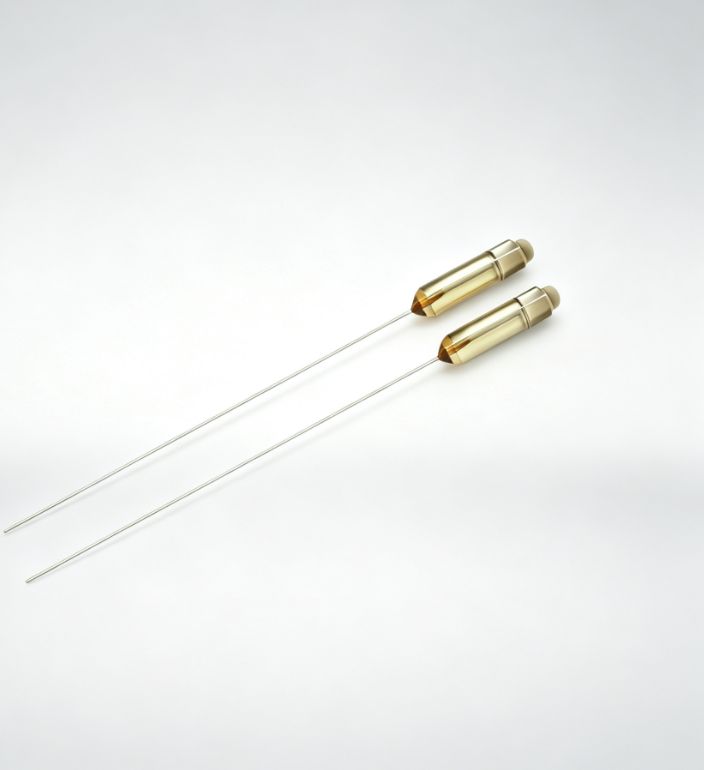
Why Does the Performance of a High-Power Fiber Collimator Degrade at High Optical Power?
为什么高功率光纤准直器在高光功率下性能会下降?
In high-power fiber lasers, fiber sensing, LiDAR, scientific instruments, and high-power optical communication systems, a fiber collimator converts the divergent light from an optical fiber into a collimated beam, or efficiently couples a collimated beam back into the fiber.
At low optical power, a fiber collimator may provide very low insertion loss, good return loss, and stable beam quality. However, as the optical power increases, some collimators may experience increased insertion loss, degraded return loss, beam drift, mode instability, or even permanent damage.
So, why can the performance of a fiber collimator decrease as optical power increases?
The answer is not simply “because the temperature rises.” Instead, multiple factors are involved, including optical absorption and heating, thermal lensing, material damage, contamination of the fiber end face, optical component instability, and changes in fiber modes.
1. Higher Optical Power Makes Even Small Absorption Significant
No optical component can achieve 100% transmission.
Even if a collimator has an insertion loss of only 0.2 dB, the corresponding optical energy can generate noticeable heat when transmitting tens of watts or even higher power.
As optical power increases, small amounts of absorption in optical components, fiber end faces, adhesives, coatings, and metal structures can result in significant temperature increases.
As the temperature rises, the refractive index, thermal expansion, and mechanical structure of the materials may change, which can further affect beam transmission.
Therefore, high-power collimator design must consider more than just low insertion loss. It should also address:
- Optical material absorption
- Coating absorption
- Fiber end-face quality
- Adhesive absorption
- Heat dissipation
- Long-term high-power stability
A small loss that can be ignored at low power may become a critical reliability factor at high power.
2. Thermal Lensing Can Change Beam Characteristics
When high-power light passes through a collimator, even a small amount of optical absorption can create a temperature gradient within the optical components.
The center region usually experiences a higher optical intensity and may therefore become hotter than the surrounding area.
This temperature distribution changes the refractive index of the material, creating an effect similar to a lens. This phenomenon is known as thermal lensing.
Thermal lensing can cause:
Changes in beam divergence → Changes in beam size → Reduced coupling efficiency → Increased insertion loss.
This effect is particularly important in high-power laser systems where beam stability and coupling efficiency are critical.
If a collimator was originally designed for a specific working distance and beam size, thermal changes may shift the system away from its optimal operating condition.
3. The Fiber End Face Is a Critical Point in High-Power Applications
The fiber end face is one of the most critical areas in a high-power optical path.
Potential problems include:
- Dust particles
- Scratches
- Contamination
- Moisture
- Uneven end-face structures
At low power, these imperfections may not cause obvious problems.
At high power, however, the local optical intensity at the fiber end face can become extremely high.
A tiny contaminant can absorb optical energy and rapidly heat up, potentially causing carbonization, ablation, or localized damage.
These defects can further increase scattering and absorption, creating a vicious cycle:
Localized absorption → Temperature increase → Material damage → Increased absorption → More severe thermal damage.
For this reason, high-power collimators require particularly strict control of fiber end-face quality, cleanliness, and assembly processes.
4. Optical Coatings Also Face Challenges at High Power
The lenses inside a fiber collimator typically use anti-reflection (AR) coatings to reduce reflection losses.
A standard coating may perform well under low-power conditions, but high-power applications impose much stricter requirements.
If the coating has relatively high absorption or microscopic defects, high-power laser irradiation can cause localized heat accumulation.
Long-term operation may result in:
- Degradation of coating performance
- Increased reflectivity
- Higher insertion loss
- Reduced beam quality
- Laser-induced damage
Therefore, a high-power collimator cannot simply use conventional optical components designed for low-power applications.
The optical material, coating technology, and laser damage threshold must all be considered.
5. Adhesives Are Another Often-Overlooked Factor
In conventional optical devices, UV adhesives and epoxy adhesives are commonly used to secure fibers, lenses, and other components.
However, adhesives can become a reliability concern in high-power applications.
Some adhesives have absorption at specific wavelengths. When exposed to high optical power for extended periods, they may experience:
Absorption → Heating → Material aging → Stress changes → Small optical displacement.
Therefore, high-power collimator designs generally aim to minimize the amount of adhesive exposed to the optical beam.
For particularly high-power applications, specialized packaging structures, reduced-adhesive designs, or other manufacturing techniques may be used to minimize direct interaction between the optical beam and absorbing materials.
6. Small Fiber-to-Lens Displacement Can Increase Insertion Loss
Under high-power conditions, temperature changes can cause different materials to expand.
For example, the fiber, metal sleeve, lens, and packaging materials do not necessarily have the same coefficient of thermal expansion.
As temperature changes, each material expands or contracts differently.
Even a very small displacement can affect:
- Fiber-to-lens alignment
- Beam center position
- Focal position
- Working distance
- Coupling efficiency
For precision fiber collimators, even micrometer-level changes can affect optical performance.
Therefore, high-power collimators require not only optimized optical designs but also stable mechanical structures and precision assembly.
7. Mode Changes Can Also Affect High-Power Transmission
For single-mode fibers, high-power fibers, and large-mode-area (LMA) fibers, the mode characteristics inside the fiber are also important.
As optical power increases, changes in the fiber mode or the occurrence of mode instability can alter the spatial distribution of the output beam.
This can affect:
- Beam size
- Beam divergence
- Beam quality
- Beam pointing
- Coupling efficiency
Therefore, when evaluating a high-power collimator, it is not enough to look only at the specified “maximum optical power.” The actual fiber type, wavelength, mode characteristics, and operating conditions should also be considered.
8. Why Does a High-Power Collimator Require More Rigorous Design?
As discussed above, a high-power fiber collimator is essentially a combination of optical, thermal, and mechanical engineering.
A collimator designed for high-power applications typically requires optimization in several areas.
Optical Design
Low-absorption optical materials should be selected, while the lens structure, beam expansion, and working distance should be carefully optimized.
Fiber End Face
The end face must have consistent quality, with contamination, defects, and localized high-intensity effects minimized.
Optical Coating
The AR coating should be selected according to the actual operating wavelength and optical power.
Packaging Structure
The optical path should be designed to minimize exposure to adhesives and other potentially absorbing materials while maintaining mechanical stability.
Thermal Management
A suitable metal structure and thermal conduction path should be designed to reduce temperature rise and minimize thermal lensing.
Assembly Precision
The concentricity between the fiber, lens, and sleeve must be carefully controlled to minimize optical drift under temperature changes.
9. How Can You Determine Whether a Fiber Collimator Is Truly Suitable for High-Power Applications?
When selecting a high-power fiber collimator, it is not enough to simply ask the supplier:
“What is the maximum optical power this collimator can handle?”
It is more important to understand the complete operating conditions.
At minimum, the following parameters should be confirmed:
| Parameter | Why It Matters |
|---|---|
| Operating wavelength | Material and coating absorption vary with wavelength |
| Maximum optical power | Indicates basic power-handling capability |
| Fiber type | Different fibers have different mode and power characteristics |
| Fiber core diameter | Affects optical power density |
| Insertion loss (IL) | Determines optical absorption and heat generation |
| Return loss (RL) | Affects reflected light and system stability |
| PDL | Indicates polarization-dependent performance |
| Working distance | Determines the position of the output beam |
| Beam size | Determines compatibility with downstream optics |
| High-power test duration | Helps evaluate long-term stability |
One important point should be emphasized:
“Can withstand a certain optical power” is not necessarily the same as “can operate reliably at that power for an extended period.”
For example, a collimator may survive a short-term high-power test, but that does not necessarily mean it can maintain the same insertion loss and beam quality after continuous operation for hours or hundreds of hours.
10. The Core of High-Power Collimator Design Is Managing the Interaction Between Light, Heat, and Mechanics
The real challenge of high-power applications is not a single component, but the entire collimator system.
As optical power increases:
Optical absorption increases → Temperature rises → Material properties change → Optical performance changes → Beam quality and coupling efficiency degrade.
If the generated heat cannot be effectively dissipated, permanent damage may eventually occur.
Therefore, the key design principles for high-power fiber collimators can be summarized as:
Minimize optical absorption + Optimize beam characteristics + Control temperature rise + Improve mechanical stability + Perform rigorous high-power testing.
Conclusion
The degradation of a high-power fiber collimator is not simply caused by “excessive optical power.” It is the result of multiple physical effects interacting with one another.
From the fiber end face and optical lens to the AR coating, adhesive, packaging structure, and thermal management, every detail can affect high-power performance.
Therefore, for high-power fiber lasers, fiber sensing systems, scientific instruments, and industrial laser systems, selecting a collimator should involve more than simply checking the maximum optical power.
Parameters such as insertion loss, beam quality, working distance, operating wavelength, fiber type, thermal stability, and long-term reliability should all be considered.
Comments are closed